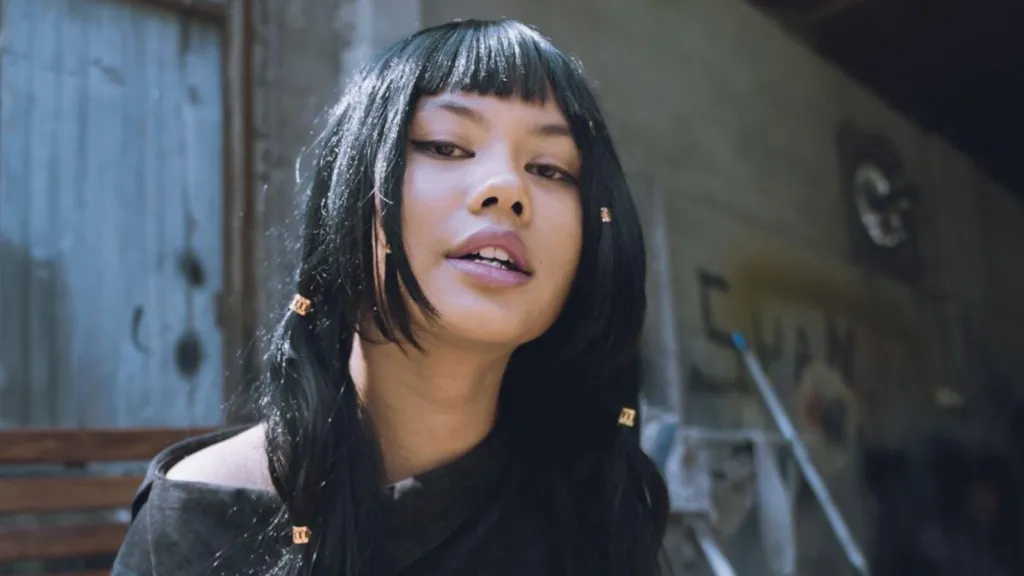
A civil engineer from Meghalaya who never quite fit in is now the most talked-about voice in desi hip-hop and she’s bringing an entire generation of women with her.
There is a particular kind of hunger in Daiaphi Lamare’s music restless, unruly, and absolutely unwilling to be quiet. It is the hunger of someone who spent years feeling like she didn’t belong anywhere: not in the engineering lecture halls of Bengaluru, not in the conservative social landscape of Meghalaya, and certainly not in a hip-hop scene that had long decided women were guests rather than residents.
Today, the 24-year-old rapper who calls herself Reble is not a guest anywhere. She is, increasingly, the main event.
In late 2025, the Bollywood spy thriller Dhurandhar stormed Indian cinema, becoming one of the highest-grossing Hindi films in history and somewhere inside its thundering soundtrack was a voice from the hills of West Jaintia Hills that stopped audiences cold. That voice was Reble’s. Her contribution, a remix built around Asha Bhosle’s classic “Piya Tu Ab To Aaja,” introduced her raw energy to millions who had never heard her name. For the underground scene that had watched her grow for six years, it felt like the moment the rest of the world finally caught up.
“I never fit in, and I didn’t have much. When I discovered hip-hop, I felt like I finally had something.”— Reble
Engineering Degree by Day,
Rap Career by Night
Reble’s upbringing was scattered across Northeast India — Shillong, the Jaintia Hills, Guwahati, and eventually Bengaluru, where she enrolled in civil engineering at Visvesvaraya Technological University. She grew up in a household where the arts were not a serious career path. When music performances clashed with her exam schedule, she chose the exam. When she began performing as a teenager, she changed her name so her family wouldn’t find out.
She graduated in 2025 the same year her career truly ignited. “I always loved science and thought I’d work as an engineer and make music on the side,” she has said, “but I got really lucky.” Luck is probably too modest a word for what happened. It was seven years of relentless
work, finding her sound in Shillong’s vibrant underground hip-hop ecosystem, building credibility through releases like her 2022 EP Entropy, and performing at stages like Bacardi NH7 Weekender while most of her peers were updating their LinkedIn profiles.
Her influences are a revealing map of her sound: Eminem for raw verbal dexterity, André 3000 for fearless experimentation, Biggie for storytelling weight, and Linkin Park for the emotional fury that sometimes needs to transcend genre. Among Indian artists, she looks up to Hanumankind and Chaar Diwaari artists who proved that authenticity, not commercial calculation, is what creates longevity.
Reble Is Not Alone A Wave Is Building
To understand why Reble rise matters, you have to understand the landscape she emerged from. Indian hip-hop has, for most of its existence, been a profoundly male space from the artists who dominate streaming charts to the festival lineups that rarely feature women except as obligatory gestures. “The only bit that grinds my gears,” Reble has said, “is when festivals pretend to care about gender equality by tossing women on the lineup.”
Yet the scene is changing, and Reble is far from its only force. A cohort of women rappers is systematically dismantling the myth that the mic belongs to men each bringing a distinct geography, language, and urgency to the art form.
Women Reshaping Desi Hip-Hop
Dee MC — Mumbai
One of Indian hip-hop’s longest-standing female voices, Dee MC has judged MTV Hustle, mentored underground artists, and represented the scene internationally in the UK, Belgium, and Canada.
Agsy — Faridabad
The only female rapper to crack the Top 15 on MTV Hustle Season 1, Agsy raps across Punjabi, Hindi, Haryanvi, and English, blending drill, reggae, and raw desi swagger.
Irfana — Kodaikanal, Tamil Nadu
A multilingual force who has worked with Def Jam Recordings India, Irfana’s verses span love, feminism, and anti-fascism. Her debut EP Ko-Lab signals a long career ahead.
Meba Ofilia — Shillong, Meghalaya
Reble’s northeast counterpart, Meba’s collaboration with Big Ri on “Done Talking” earned an MTV Europe Music Award — putting Meghalaya’s hip-hop scene on the global map.
Mahi G — Environmental rap
Using hip-hop as activism, Mahi G’s verses connect climate justice, gender discrimination, and social inequality rap as conscience, not just craft.
What unites these artists is not a shared aesthetic — their sounds are as different as their backgrounds but a shared refusal to shrink. They are rapping in Hindi, English, Tamil, and the languages of the northeast. They are addressing police violence, body politics, family expectation, romantic longing, and the weight of belonging to a country that often does not know what to do with ambitious women.
“There’s so much untapped potential. I believe more women should step up and make rap music. There’s always something to say, and rap gives you the outlet to say it.”— Reble
A Scene in Transformation
The indicators suggest this is not a momentary trend. In April 2025, Reble appeared on Rolling Stone India’s Future of Music list. Her single “New Riot” released via Atlantic Records in collaboration with Homegrown Music, and performed at India’s first Rolling Loud festival announced an artist entering a new phase: louder, more experimental, and with considerably more infrastructure behind her. The song blended distorted synths with Memphis rap influences and described itself as “an anthem of rage, chaos, and release.” It sounded, in other words, like a mission statement.
In March 2026, she returned with contributions to Dhurandhar: The Revenge, the blockbuster’s sequel. A profile in GQ India followed in February. The civil engineer from Meghalaya who used a fake name to hide her music from her family is now on the cover of national magazines.
Yet the modesty endures. “I don’t think I am a DHH star,” she said recently. “I am not there yet — but I hope to become one someday.” It is a line that sounds less like humility and more like a warning. She is building something, one bar at a time, and she has made very clear that she is just getting started.
Indian hip-hop has always thrived on stories of outsiders fighting their way in. Reble’s story — the misfit from the hills, the engineer who chose the stage, the woman in a genre that told her to wait — may be the most compelling chapter the scene has produced in years. And for the wave of women following behind her, it is more than a story. It is a door, left wide open.
Reble story: Daiaphi Lamare, known professionally as Reble, hails from Meghalaya and blends hip-hop with trap, hardcore, alternative, and R&B. She was born in Nangbah in West Jaintia Hills and grew up immersed in Khasi and Pnar cultural influences, before gaining widespread recognition through her songs in the Bollywood film Dhurandhar in December 2025.
The broader wave: Mahi G, Srishti Tawade, Saniya MQ, and Reble are among the artists redefining hip-hop, addressing questions of identity, climate change, and violence against women. As Reble herself put it, there is “so much untapped potential” and she believes “more women should step up and make rap music.”
What makes this moment different: over the past decade, the desi hip-hop genre has experienced a revolution, thanks to social media and reality TV shows that have helped turn these rappers into household names, giving artists like Reble a platform that didn’t exist for the generation before them.